
What Is a Free Hit in Cricket?
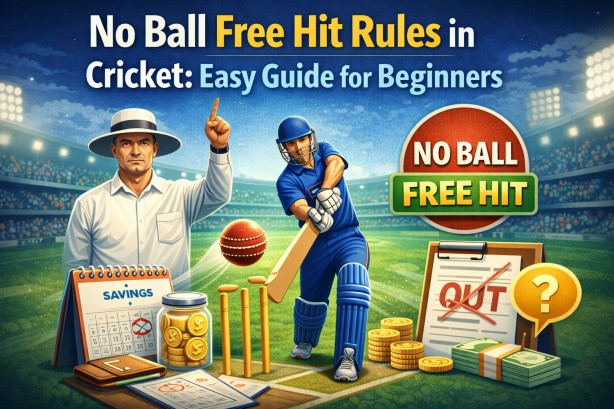
A free hit is a special delivery given to the batter after certain types of no balls. During a free hit, the batter cannot be dismissed in most ways, which encourages aggressive batting.
The concept of a free hit was introduced to make limited-overs cricket more exciting.
When Is a Free Hit Awarded?
A free hit is usually awarded after a front-foot no ball.
This means when a bowler oversteps the crease, the next ball becomes a free hit.
The umpire signals a free hit by rotating one arm in a circular motion above the head.
Key No Ball Free Hit Rules
Understanding the no ball free hit rules is essential for following modern cricket matches. Below are the most important rules.
1. The Batting Team Gets One Extra Run
Whenever a no ball is called:
-
The batting team receives one extra run
-
Any runs scored off the bat are also added
For example, if the batter hits a boundary on a no ball, the team receives five runs (1 extra + 4 runs).
2. The Ball Must Be Rebowled
A no ball does not count as a legal delivery in the over.
The bowler must bowl an extra ball to complete the over.
3. Free Hit Applies After Front-Foot No Ball
In limited-overs formats:
-
A front-foot no ball results in a free hit on the next delivery.
This rule is common in T20 and ODI cricket.
4. Batter Cannot Be Out on a Free Hit
During a free hit, the batter cannot be dismissed in most ways.
The batter cannot be out by:
-
Bowled
-
Caught
-
LBW
-
Stumped
However, the batter can still be dismissed by:
-
Run out
-
Obstructing the field
-
Hitting the ball twice
This makes the free hit a big opportunity for scoring runs.
5. Fielding Positions Cannot Change
During a free hit, the fielding team cannot change the field placement unless the striker changes.
This prevents the bowling team from gaining an unfair advantage.
Read for more Blog – Umpire Signals Cricket: Complete Guide for Beginners in 2026
Why No Ball and Free Hit Rules Matter
The no ball free hit rules serve several purposes in modern cricket:
1. Maintain Fair Play
They punish bowlers for illegal deliveries.
2. Encourage Accurate Bowling
Bowlers must be careful with their foot placement.
3. Increase Entertainment
Free hits create exciting moments where batters often try to hit big shots.
Impact in T20 Cricket
In T20 matches, the no ball free hit rules often change the momentum of the game.
A single no ball can lead to:
-
Extra runs
-
A free hit boundary
-
Pressure on the bowler
Because of this, teams rely heavily on disciplined bowling.
Conclusion
The no ball free hit rules are an important part of modern cricket, especially in limited-overs formats. These rules ensure fair play while adding excitement to the game.
Whenever a bowler delivers an illegal ball, the batting team benefits with extra runs and sometimes a free hit. This encourages bowlers to maintain accuracy and discipline while giving batters thrilling scoring opportunities.
Understanding these rules helps fans enjoy cricket more and follow the game with greater clarity.
FAQs: No Ball & Free Hit Rules
1. What is a no ball in cricket?
A no ball is an illegal delivery bowled by the bowler, resulting in an extra run for the batting team and usually a free hit in limited-overs cricket.
2. What is a free hit in cricket?
A free hit is a delivery where the batter cannot be dismissed in most ways, usually awarded after a front-foot no ball.
3. Can a batter be out on a free hit?
Yes, but only through run out, obstructing the field, or hitting the ball twice.
4. Does a no ball count in the over?
No. A no ball does not count as a legal delivery, so the bowler must bowl another ball.
5. When was the free hit rule introduced?
The free hit rule was introduced in limited-overs cricket to make the game more exciting and penalize illegal deliveries.
6. Can runs scored on a free hit include boundaries?
Yes. Batters can score runs normally, including fours and sixes, on a free hit.