
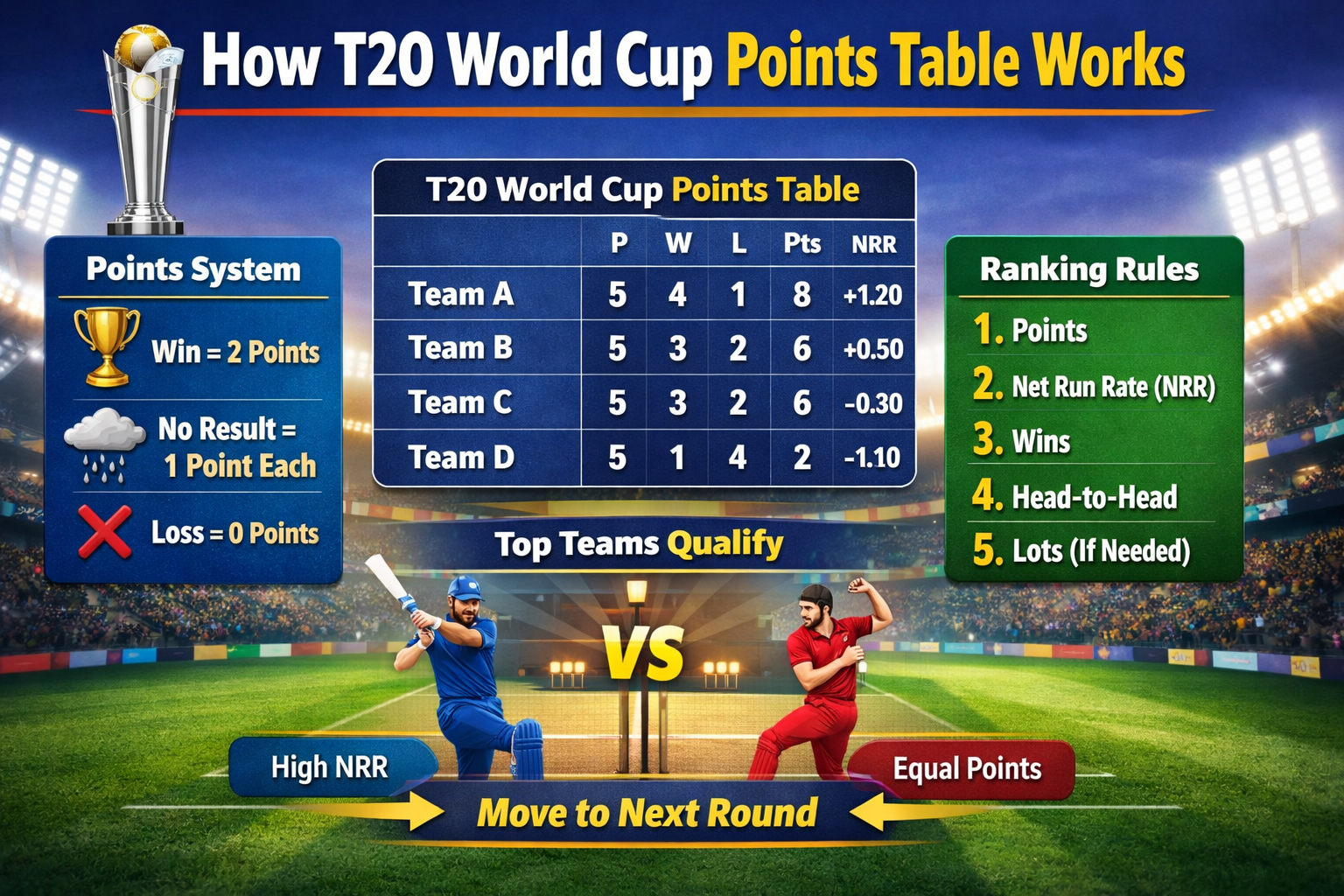
How T20 World Cup Points Table Works
How does the T20 World Cup points table work? (Direct Answer)
The T20 World Cup points table rules are simple.
Teams earn points based on match results, and rankings are decided using points, Net Run Rate (NRR), and wins.
The points table decides which teams qualify for the next round of the tournament.
What is the T20 World Cup Points Table?
The T20 World Cup points table is a ranking system used during the group stage and Super stages.
It shows:
-
Matches played
-
Wins and losses
-
Points earned
-
Net Run Rate (NRR)
-
Team position in the group
Based on the T20 World Cup points table rules, only top teams move ahead.
How are points awarded in the T20 World Cup?
Points system explained
According to official T20 World Cup points table rules:
-
Win → 2 points
-
No Result / Abandoned match → 1 point each
-
Loss → 0 points
There are no bonus points in the T20 World Cup.
What happens if a match is abandoned due to rain?
If a match is:
-
Washed out
-
Abandoned without a result
Then:
-
Both teams receive 1 point each
This rule applies across all stages and is part of standard T20 World Cup points table rules.
How are teams ranked in the T20 World Cup points table?
Teams are ranked using the following order:
-
Total points
-
Net Run Rate (NRR)
-
Number of wins
-
Head-to-head result
-
Drawing of lots (very rare)
This ranking method ensures fairness under T20 World Cup points table rules.
What is Net Run Rate (NRR) and why is it important?
Understanding NRR in simple terms
Net Run Rate is the difference between runs scored per over and runs conceded per over.
Formula (simplified):
Runs scored ÷ overs faced − runs conceded ÷ overs bowled
NRR becomes crucial when:
-
Teams finish with equal points
-
Qualification spots are tight
A higher NRR improves a team’s position in the T20 World Cup points table.
How does NRR affect qualification?
Even if two teams have:
-
Same points
-
Same wins
The team with better NRR ranks higher.
Many teams have qualified or been eliminated in past tournaments due to NRR under T20 World Cup points table rules.
How many teams qualify from the points table?
This depends on the stage:
Group Stage
-
Top teams from each group qualify
-
Exact number depends on tournament format
Super Stage
-
Usually top 2 teams advance to semifinals
The points table is the only deciding factor for qualification.
Are Super Over results counted in the points table?
Yes.
If a Super Over decides the match:
-
The winner gets 2 points
-
The loser gets 0 points
NRR is calculated based on the match result, not Super Over runs.
Can teams qualify without winning many matches?
Yes, but it is rare.
A team can qualify if:
-
Other matches are abandoned
-
NRR is significantly better
Still, wins remain the most important factor under T20 World Cup points table rules.
Common mistakes fans make about the points table
Many fans believe:
-
Boundary count affects points
-
Bonus points exist
-
Super Over runs change NRR
All these are incorrect as per official T20 World Cup points table rules.
Why the T20 World Cup points table is crucial
The points table:
-
Decides qualification
-
Builds match pressure
-
Makes every over important
Even one bad loss can drop a team due to NRR impact.
Conclusion
The T20 World Cup points table rules are designed to keep the tournament fair and competitive.
Every win, run, and over matters.
Understanding how the points table works helps fans follow the tournament more clearly and predict qualification scenarios better.
Frequently Asked Questions
1. How many points are awarded for a win in T20 World Cup?
A team gets 2 points for a win under T20 World Cup points table rules.
2. What if two teams have the same points?
Teams are ranked by Net Run Rate first, then wins, and head-to-head results.
3. Does rain-affected match affect qualification?
Yes. Rain-abandoned matches give 1 point each, which can impact final standings.
4. Is Net Run Rate more important than wins?
NRR is used only when points are equal, not before.
5. Are Super Over runs included in Net Run Rate?
No. Super Over runs do not count in NRR calculations.