
Swing vs Seam Bowling Explained: Key Differences Every Cricket Fan Should Know
Cricket bowling is an art, and among fast bowlers, two techniques often create confusion—swing bowling and seam bowling. Understanding swing vs seam bowling is essential for fans who want deeper insight into how bowlers dominate matches across formats. While both styles are used by pace bowlers, their movement, conditions, and execution are very different.
In this detailed swing vs seam bowling guide, we break down the core differences, explain how each works, and highlight when and why bowlers use them.
What Is Swing Bowling?
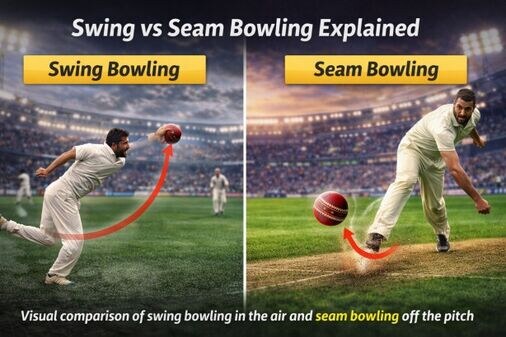
Swing bowling refers to lateral movement of the ball in the air before it reaches the batter. In swing vs seam bowling, swing depends heavily on aerodynamics.
How Swing Bowling Works
-
One side of the ball is kept shiny, the other rough
-
Air flows differently around each side
-
This causes the ball to move sideways in the air
There are two main types:
-
Conventional swing – common with a newer ball
-
Reverse swing – occurs with an older ball at high speeds
Swing bowling is especially effective in overcast conditions and with a new ball, making it a major weapon in Tests and ODIs.
What Is Seam Bowling?
Seam bowling involves movement after the ball hits the pitch. In the swing vs seam bowling comparison, seam bowling relies more on precision than air movement.
How Seam Bowling Works
-
The bowler lands the ball on the seam
-
Uneven pitch contact causes deviation
-
Movement occurs off the surface, not in the air
Seam bowling is most effective on:
-
Green or grassy pitches
-
Fresh surfaces with moisture
-
Test match conditions
Unlike swing, seam bowling does not depend heavily on ball shine or weather.
Swing vs Seam Bowling: Key Differences
Understanding swing vs seam bowling becomes easier when comparing them directly.
| Aspect | Swing Bowling | Seam Bowling |
|---|---|---|
| Movement | In the air | Off the pitch |
| Key Factor | Ball condition & air | Pitch & seam position |
| Best Conditions | Overcast, humid | Green or uneven pitch |
| Ball Age | New or very old | Any |
| Common Format | ODI, Test | Test |
This swing vs seam bowling distinction explains why some bowlers excel overseas while others dominate at home.
Which Is More Difficult: Swing or Seam Bowling?
Both techniques are challenging but in different ways. In swing vs seam bowling, swing requires:
-
Consistent ball maintenance
-
Precise wrist position
-
Suitable atmospheric conditions
Seam bowling demands:
-
Pinpoint accuracy
-
Strong wrist control
-
Repetition and patience
Elite fast bowlers often master both to stay effective in all conditions.
Famous Bowlers Known for Swing and Seam
In the history of cricket, legends have excelled in either or both styles, proving the importance of swing vs seam bowling balance.
Swing Specialists
-
Wasim Akram
-
James Anderson
-
Bhuvneshwar Kumar
Seam Specialists
-
Glenn McGrath
-
Courtney Walsh
-
Mohammad Shami
Modern fast bowlers blend swing vs seam bowling techniques to remain unpredictable.
Swing vs Seam Bowling in Modern Cricket
In T20 cricket, swing is limited due to flatter pitches and older balls, while seam movement off hard lengths remains crucial. In Tests, swing vs seam bowling becomes a strategic battle influenced by pitch, weather, and ball age.
Captains and coaches now plan spells based on this swing vs seam bowling understanding to maximize wicket-taking opportunities.
Read for More Blog – best T20 spinners
Conclusion
The debate of swing vs seam bowling is not about which is better, but about when and how each is used. Swing bowling dominates the air, seam bowling controls the pitch, and together they form the backbone of fast bowling success.
For any cricket fan, understanding swing vs seam bowling adds a new layer of appreciation to every delivery bowled.
FAQ
1. What is the main difference between swing vs seam bowling?
Swing moves the ball in the air, while seam movement happens after pitching.
2. Which is more effective in Test cricket?
Both are important, but seam bowling is often more reliable on green pitches.
3. Does swing bowling depend on weather?
Yes, humidity and cloud cover help swing bowling significantly.
4. Can a bowler use both swing and seam bowling?
Yes, many top fast bowlers use both depending on conditions.
5. Which is harder to play for batters?
Swing troubles batters early, while seam movement causes uncertainty off the pitch.
6. Is swing vs seam bowling relevant in T20 cricket?
Yes, though seam bowling is more common due to flatter pitches.