


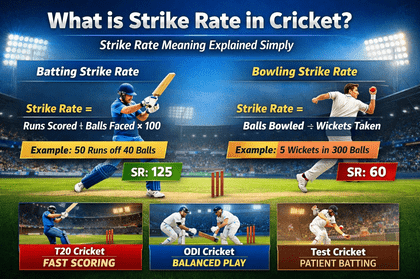
Cricket is a game of numbers, and among all the statistics used to judge a player’s performance, strike rate is one of the most important. Whether you are watching T20 cricket, ODIs, or even Test matches, commentators and experts often talk about a player’s strike rate to explain their impact on the game.
So, what is strike rate in cricket, and why does it matter so much today? In this article, we’ll break down the strike rate meaning in cricket, how it is calculated, why it is important in different formats, and how it affects team strategy.
Strike Rate Meaning in Cricket
The strike rate meaning in cricket refers to how quickly a player scores runs. Simply put, strike rate measures the number of runs a batter scores per 100 balls faced.
It is used to judge:
-
How aggressive a batter is
-
How fast a team is scoring
-
A player’s effectiveness in limited-overs cricket
A higher strike rate means faster scoring, while a lower strike rate indicates a slower approach.
What is Strike Rate in Cricket for Batsmen?
For batsmen, strike rate shows scoring speed rather than total runs.
Strike Rate Formula (Batting)
Strike Rate = (Runs Scored ÷ Balls Faced) × 100
Example
If a batter scores:
-
50 runs off 40 balls
Strike rate = (50 ÷ 40) × 100 = 125
This means the batter scores 125 runs per 100 balls, which is considered aggressive in most formats.
Why is Strike Rate Important in Cricket?
Strike rate has become crucial because modern cricket is no longer just about surviving at the crease.
1. Impact on Team Score
A high strike rate helps teams:
-
Set bigger totals
-
Chase targets more comfortably
-
Control the match tempo
2. Essential in T20 and ODI Cricket
In limited-overs formats, scoring quickly is often more valuable than scoring big individually.
3. Player Selection
Teams prefer players who:
-
Maintain consistency
-
Score runs quickly under pressure
This is why finishers and power-hitters are judged heavily on strike rate.
Strike Rate in Different Formats of Cricket
Strike Rate in T20 Cricket
-
Ideal strike rate: 130–160+
-
Power-hitters often cross 150
-
Even anchors are expected to stay above 120
In T20s, a low strike rate can hurt the team badly.
Strike Rate in ODI Cricket
-
Ideal strike rate: 85–110
-
Top-order batters may start slow and accelerate later
-
Finishers usually have higher strike rates
ODIs require balance between stability and aggression.
Strike Rate in Test Cricket
-
Strike rate is less important
-
Focus is on:
-
Time spent at the crease
-
Wearing down bowlers
-
A Test strike rate of 45–60 is perfectly acceptable.
Bowling Strike Rate Explained
Strike rate is not just for batters. Bowlers also have a strike rate, but its meaning is different.
Bowling Strike Rate Meaning
It shows how frequently a bowler takes wickets.
Bowling Strike Rate Formula
Bowling Strike Rate = Balls Bowled ÷ Wickets Taken
Example
If a bowler takes:
-
5 wickets in 300 balls
Strike rate = 300 ÷ 5 = 60
This means the bowler takes one wicket every 60 balls.
Good vs Bad Strike Rate (Batting)
| Format | Low Strike Rate | Average | Excellent |
|---|---|---|---|
| T20 | Below 110 | 120–135 | 140+ |
| ODI | Below 75 | 80–95 | 100+ |
| Test | Below 40 | 45–60 | Not critical |
A “good” strike rate always depends on the match situation and format.
Does High Strike Rate Always Mean Better Performance?
Not necessarily.
A player scoring:
-
30 runs at 180 strike rate
-
vs
-
70 runs at 90 strike rate
Both can be valuable depending on:
-
Match format
-
Pitch condition
-
Team requirement
This is why strike rate should always be viewed along with runs scored.
Common Misconceptions About Strike Rate
1. Higher Strike Rate Means Better Player
Wrong. Consistency and match awareness matter just as much.
2. Strike Rate is Only for Batters
Incorrect. Bowlers’ strike rate is equally important.
3. Low Strike Rate is Always Bad
In Tests or tough conditions, a low strike rate can be match-winning.
How Players Improve Their Strike Rate
Professional cricketers improve strike rate by:
-
Better shot selection
-
Fitness and quick running between wickets
-
Practicing boundary options
-
Reading bowlers early
Modern coaching focuses heavily on strike rotation and power-hitting.
Read For more Blog – DLS method explained
Strike Rate vs Average: Which is More Important?
| Metric | What it Shows |
|---|---|
| Batting Average | Consistency |
| Strike Rate | Scoring speed |
In modern cricket, especially T20s, strike rate often matters more than average.
Conclusion
Understanding what is strike rate in cricket helps fans appreciate the game beyond just runs and wickets. The strike rate meaning in cricket is simple—it shows how fast a player scores or how quickly a bowler takes wickets.
While a high strike rate is vital in T20 and ODI cricket, context always matters. The best players know when to attack and when to slow down, making strike rate a powerful but situational statistic.
Frequently Asked Questions
1. What is strike rate meaning in cricket?
Strike rate means the number of runs a batter scores per 100 balls faced.
2. What is a good strike rate in T20 cricket?
A strike rate above 130 is considered good in T20 matches.
3. How is strike rate calculated in cricket?
Strike rate = (Runs scored ÷ Balls faced) × 100.
4. Is strike rate important in Test cricket?
Not much. In Tests, survival and consistency matter more.
5. What is bowling strike rate?
Bowling strike rate shows how many balls a bowler takes to get one wicket.
6. Which is more important: average or strike rate?
It depends on the format, but in T20 cricket, strike rate is often more important.