


Duckworth Lewis Method Explained Simply
Cricket is a game where weather can completely change the outcome. Rain, bad light, or other interruptions often force matches to be shortened. To ensure fairness in such situations, cricket uses a special mathematical formula called the Duckworth-Lewis-Stern method, commonly known as DLS. In this article, we provide a DLS method explained guide in the simplest possible way so that even casual cricket fans can understand how revised targets are calculated.
Whether you have wondered why teams suddenly get strange targets like 237 in 28 overs or felt confused during rain-affected matches, this guide will clear everything step by step.
What Is the Duckworth-Lewis-Stern (DLS) Method?
The Duckworth-Lewis-Stern method is a mathematical system used in limited-overs cricket (ODIs and T20s) to recalculate target scores when a match is interrupted.
The core idea behind the DLS method is simple:
A team’s ability to score runs depends on two resources —
overs remaining and wickets in hand.
If either of these resources is reduced due to rain or interruptions, the target must change to keep the contest fair.
Why Was the DLS Method Introduced?
Before DLS, revised targets were often unfair. Earlier methods only reduced overs without considering wickets lost. This led to situations where teams with many wickets in hand were unfairly advantaged or disadvantaged.
The Duckworth-Lewis method was introduced in the 1990s by statisticians Frank Duckworth and Tony Lewis. Later, Australian professor Steven Stern refined it further, leading to the modern Duckworth-Lewis-Stern (DLS) system used today.
The Basic Concept Behind the DLS Method Explained
To understand the DLS method explained simply, remember one key rule:
More overs + more wickets = more scoring potential
DLS uses percentage tables that assign a resource value to every match situation based on:
-
Overs remaining
-
Wickets lost
For example:
-
50 overs with 10 wickets = 100% resources
-
25 overs with 5 wickets = much less than 50% resources
When rain reduces overs, the system recalculates how many resources the chasing team actually has and adjusts the target accordingly.
How the DLS Method Works Step by Step
Step 1: First Team Sets a Score
The team batting first uses 100% of its available resources (unless they are also interrupted).
Step 2: Interruption Occurs
Rain or bad light reduces the overs available for the second team.
Step 3: Resources Are Recalculated
Using DLS tables, the match officials calculate:
-
Original resources available
-
Revised resources after interruption
Step 4: New Target Is Set
The chasing team’s target is adjusted based on the percentage of resources remaining.
This ensures the match remains competitive and balanced.
Simple Example of DLS Method Explained
Let’s take an easy example:
-
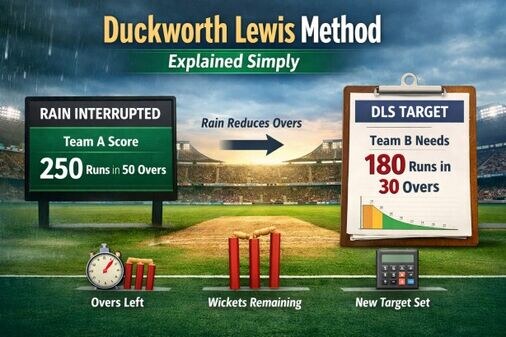
Team A scores 250 runs in 50 overs
-
Team B’s chase is reduced to 30 overs due to rain
Under DLS:
-
Team B does NOT simply need 150 runs (half of 250)
-
The system considers that Team B has fewer overs but still has 10 wickets
As a result, Team B might get a revised target like 180 runs in 30 overs, depending on the resource calculation.
This makes the contest fairer than simple proportional reduction.
What Are Resources in the DLS Method?
In DLS terminology, resources mean a team’s scoring ability at any point in time.
Resources depend on:
-
Overs left
-
Wickets remaining
For instance:
-
20 overs left with 8 wickets = high resources
-
20 overs left with 2 wickets = low resources
That is why losing wickets early can heavily impact revised targets.
Difference Between DL and DLS Method
Many fans still call it the Duckworth-Lewis method, but officially it is now the Duckworth-Lewis-Stern (DLS) method.
The main improvement Stern made was:
-
Better handling of high-scoring matches
-
More accurate predictions in modern aggressive cricket
Today, all ICC matches use the DLS method.
DLS Method in T20 vs ODI Matches
The DLS method works in both formats, but its impact is more visible in T20 cricket because:
-
Fewer overs mean higher scoring pressure
-
Small changes in overs can drastically change targets
In ODIs, the effect is usually smoother because of longer innings.
Common Criticism of the DLS Method
Despite being the best available system, DLS is not perfect.
Some common criticisms include:
-
It favors teams batting second in certain scenarios
-
Fans find the calculations confusing
-
Targets sometimes look unrealistic
However, no alternative method has proven more accurate or fair over time.
Why DLS Is Still the Best System Available
Even with its flaws, the DLS method remains:
-
Statistically sound
-
Widely tested
-
Consistently fair compared to older methods
It ensures rain-affected matches still produce meaningful results rather than abandoned games.
Read For more Blog – powerplay rules in cricket
Conclusion: DLS Method Explained in Simple Terms
To sum up the DLS method explained:
-
Cricket matches rely on overs and wickets as resources
-
Rain reduces these resources
-
DLS recalculates fair targets using statistical models
While it may look complex on screen, the logic behind it is straightforward — fair play despite interruptions. Understanding DLS enhances your enjoyment of modern cricket, especially in rain-affected thrillers.
Frequently Asked Questions
1. What does DLS stand for in cricket?
DLS stands for Duckworth-Lewis-Stern, the method used to revise targets in interrupted limited-overs matches.
2. Is the DLS method used in Test cricket?
No, the DLS method is only used in ODI and T20 matches.
3. Why are DLS targets sometimes odd numbers?
Because targets are based on resource percentages, not simple run-rate calculations.
4. Who decides the revised DLS target?
Match officials use official ICC DLS software to calculate revised targets.
5. Is the DLS method fair?
While not perfect, it is considered the fairest system available for rain-affected matches.
6. Can DLS be applied if both teams are interrupted?
Yes, DLS adjusts resources for both innings if interruptions occur.