
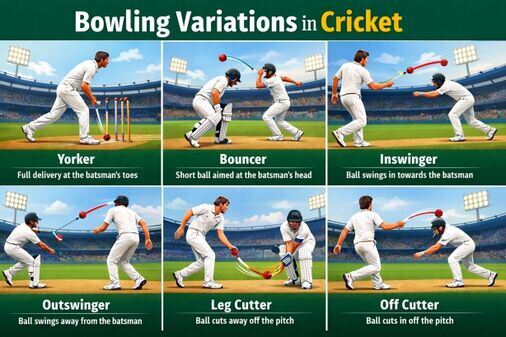
Cricket is not just about speed and strength; it is also about skill and strategy. One of the most important aspects of modern cricket is mastering bowling variations in cricket. Whether in Test matches, ODIs, or T20s, bowlers rely on variations to outsmart batters and break partnerships.
Understanding different bowling variations in cricket helps fans appreciate how bowlers control the game and create wicket-taking opportunities.
Table of Contents
ToggleWhat Are Bowling Variations in Cricket?
Bowling variations in cricket refer to different types of deliveries used by bowlers to deceive batters. Instead of bowling at the same pace or line repeatedly, bowlers mix up their deliveries to confuse timing and shot selection.
These variations can include:
-
Change in pace
-
Change in line and length
-
Different grip and wrist positions
-
Spin and seam adjustments
Variations are especially important in limited-overs cricket, where unpredictability is key.
Fast Bowling Variations in Cricket
Fast bowlers use several clever techniques to keep batters guessing.
1. Slower Ball
The slower ball is one of the most effective bowling variations in cricket, especially in T20 matches. The bowler delivers the ball with a reduced pace while maintaining the same action, deceiving the batter.
2. Yorker
A perfectly executed yorker targets the base of the stumps. It is a crucial weapon in death overs and one of the most dangerous bowling variations in cricket.
3. Bouncer
The short-pitched delivery aimed at the batter’s upper body forces discomfort and mistimed shots.
4. Off-Cutter & Leg-Cutter
These deliveries grip the pitch and deviate after bouncing, adding unpredictability.
Spin Bowling Variations in Cricket
Spin bowlers rely heavily on different types of bowling variations in cricket to take wickets.
1. Doosra
An off-spinner’s surprise weapon that turns the opposite way.
2. Googly
A leg-spinner’s deceptive delivery that spins in the opposite direction.
3. Flipper
A quicker, skidding delivery that stays low.
4. Arm Ball
A straight delivery that surprises batters expecting spin.
These variations help spinners dominate middle overs in limited-overs cricket.
Why Bowling Variations Are Important
Modern cricket is highly competitive, and batters are skilled at attacking predictable bowling. This is why bowling variations in cricket play a crucial role in success.
Key benefits:
-
Break batting rhythm
-
Create wicket-taking chances
-
Control run flow
-
Build pressure in crucial moments
Without effective variations, bowlers struggle to survive in fast-paced formats like T20 cricket.
Read for more blog – Suryakumar Yadav vs USA
Bowling Variations in T20 Cricket
In T20 matches, bowling variations in cricket are essential. Bowlers often rely on:
-
Slower balls in death overs
-
Wide yorkers
-
Back-of-the-hand slower deliveries
-
Knuckleballs
Because batters attack from the first ball, mixing up pace and length becomes the difference between conceding runs and taking wickets.
How Bowlers Master Variations
Becoming skilled at bowling variations in cricket requires:
-
Consistent practice
-
Wrist and finger control
-
Reading the batter’s intent
-
Strong mental focus
Elite bowlers practice subtle changes without revealing them through body language, making their variations more effective.
Conclusion
The importance of bowling variations in cricket cannot be overstated. From deadly yorkers to deceptive googlies, variations define modern bowling success. In today’s aggressive cricket era, bowlers who master different variations remain ahead of batters.
Whether you are a beginner learning the basics or a fan trying to understand the game better, knowing about bowling variations in cricket adds deeper insight into match strategies and performances.
FAQ
1. What are bowling variations in cricket?
They are different types of deliveries used by bowlers to deceive batters.
2. Which variation is most effective in T20 cricket?
Slower balls and yorkers are highly effective in T20 matches.
3. Do spinners rely more on variations than fast bowlers?
Yes, spin bowling depends heavily on variations.
4. Why are variations important in death overs?
They prevent batters from predicting pace and timing big shots.
5. Can beginners learn bowling variations easily?
With proper coaching and practice, beginners can gradually master basic variations.
6. Which format requires the most variations?
T20 cricket demands the highest use of bowling variations.