
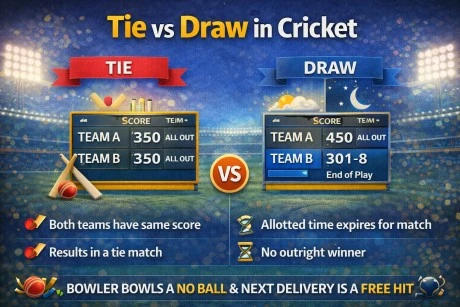
A tie happens when both teams finish with exactly the same score at the end of the match, and all innings are completed.
Key Points of a Tie:
- Both teams score equal runs
- All innings are completed
- No winner is decided directly
- In limited-overs matches, a tiebreaker may follow
Example:
If Team A scores 250 runs and Team B also scores 250 runs, the match is declared a tie.
In modern formats like ODIs and T20s, ties are usually resolved using a Super Over.
What is a Draw in Cricket?
A draw occurs only in longer formats like Test cricket when the match ends without a result because time runs out.
Key Points of a Draw:
- Match is incomplete due to time limit
- Both teams may not finish their innings
- No winner or loser
- Happens only in multi-day matches
Example:
If a Test match ends after 5 days and the chasing team has not completed their innings, the match is declared a draw.
Tie vs Draw in Cricket: Main Difference
Here is the simplest way to understand Tie vs Draw in Cricket:
| Feature | Tie | Draw |
|---|---|---|
| Score | Equal scores | Not necessarily equal |
| Match Completion | Fully completed | Not completed |
| Format | All formats | Only Test cricket |
| Result | Equal outcome | No result due to time |
| Winner | No direct winner | No winner |
Tie vs Draw in Different Formats
1. Test Cricket
In Test matches, both tie and draw are possible.
- Tie: Extremely rare
- Draw: Very common
One of the most famous tied Test matches occurred in 1960 between Australia and West Indies.
2. One Day Internationals (ODIs)
In ODIs:
- Draw is almost impossible
- Tie can happen if scores are equal
Modern ODIs use:
- Super Over (in knockout matches)
3. T20 Cricket
In T20 matches:
- Draw does not exist
- Tie leads to a Super Over
This ensures that a winner is always decided.
Famous Tie Matches in Cricket History
Here are some iconic tied matches:
- Australia vs West Indies (1960 Test)
- India vs Sri Lanka (2011 World Cup Final stage tie scenario avoided)
- Multiple T20 matches decided by Super Over
Tied matches are rare and often very exciting.
Why Draws Happen in Test Cricket
Draws are common in Test cricket because of:
- Time limit (5 days)
- Weather interruptions
- Defensive batting
- Slow scoring rates
Teams often play defensively to avoid losing, which can lead to a draw.
Why Ties Are Rare
A tie requires perfect equality in scores after full completion of the match.
This is rare because:
- Matches usually end with a winner
- Small differences in performance matter
- Pressure situations lead to mistakes
That’s why tied matches are considered historic moments.
Tie vs Draw: Which is More Exciting?
- Tie: Very exciting, nail-biting finish
- Draw: Depends on match situation, sometimes boring
In modern cricket, fans prefer matches that produce a clear winner, which is why formats like T20 avoid draws completely.
Super Over in Case of Tie
In limited-overs cricket, ties are resolved using a Super Over.
How it works:
- Each team plays 1 over (6 balls)
- Team scoring more runs wins
- If still tied, more Super Overs are played
This rule makes matches more thrilling and ensures a result.
Common Misconceptions
Tie and Draw are the same
False — they are completely different results
Draw can happen in T20
False — T20 always produces a winner
Tie happens due to incomplete match
False — tie requires full completion
Importance of Understanding Tie vs Draw
Knowing the difference helps you:
- Understand match results better
- Enjoy cricket more deeply
- Avoid confusion during commentary
- Improve cricket knowledge
For bloggers like you, this topic is also low competition + high search intent, making it great for SEO.
Conclusion
The difference between Tie vs Draw in Cricket is simple but important. A tie happens when both teams finish with equal scores after completing the match, while a draw occurs when a match ends without a result due to time constraints.
Understanding these terms will not only improve your cricket knowledge but also help you enjoy matches more. Whether you’re watching a thrilling T20 or a strategic Test match, knowing the result type adds more excitement to the game.
FAQs: Tie vs Draw in Cricket
1. What is the difference between tie and draw in cricket?
A tie occurs when both teams score equal runs, while a draw happens when a match ends without a result due to time.
2. Can a T20 match end in a draw?
No, T20 matches cannot end in a draw. If scores are equal, a Super Over decides the winner.
3. How rare is a tie in cricket?
Ties are very rare, especially in Test cricket. Only a few tied Test matches have occurred in history.
4. Why do Test matches end in a draw?
Test matches end in a draw when time runs out before a result is achieved.
5. What happens if an ODI match is tied?
In knockout matches, a Super Over is used to decide the winner. In league matches, it may remain a tie.