
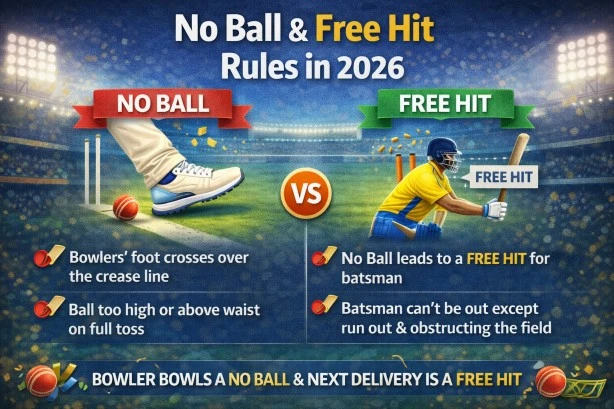
Cricket rules continue to evolve, especially in the fast-paced T20 format. The No Ball & Free Hit Rules in 2026 have become even more important, directly impacting match outcomes in leagues like the Indian Premier League and international cricket.
In this news-style guide, we explain the latest No Ball & Free Hit Rules, recent updates, and how they differ between IPL and international matches.
What Is a No Ball in 2026?
A no ball is still an illegal delivery, but technology has made detection stricter and faster in 2026.
Latest Updates (2026)
- Front-foot no balls are now automatically detected using technology (third umpire support).
- Umpires receive instant alerts, reducing human error.
- Strict checks on waist-high full tosses for safety reasons.
Common Reasons for No Ball
- Overstepping the crease
- Dangerous full toss (above waist height)
- Illegal bowling action
- Fielding restrictions violation
Penalty remains the same:
- 1 extra run + free hit (in limited overs cricket)
Free Hit Rule in 2026
The free hit rule continues to be one of the most exciting aspects of T20 cricket.
When Is a Free Hit Given?
- After a front-foot no ball
- In both IPL and international white-ball cricket
Latest Free Hit Updates
- Fielding team cannot change field unless striker changes
- Batter can play aggressively with minimal risk
- Technology ensures correct free hit tracking
Dismissals Allowed on Free Hit
Even in 2026, the rules remain mostly unchanged:
Batter CANNOT be out by:
- Bowled
- Caught
- LBW
- Stumped
Batter CAN be out by:
- Run out
- Obstructing the field
- Hit the ball twice
This makes free hits a huge advantage for batters.
Why These Rules Matter in 2026
The updated No Ball & Free Hit Rules are designed to:
- Improve fairness using technology
- Increase scoring and entertainment
- Punish bowlers for illegal deliveries
- Ensure player safety
These rules are now a game-changing factor in close matches.
IPL vs International Rules (Key Differences)
Although the core No Ball & Free Hit Rules are similar, there are some practical differences between IPL and international cricket.
In IPL
- Faster technology integration (real-time no ball detection)
- More aggressive batting approach due to league format
- Umpires rely heavily on third umpire support
In International Cricket
- Slightly more traditional umpiring (though tech is used)
- More focus on discipline and consistency
- Rules strictly governed by International Cricket Council
Overall, IPL games tend to see more impact from free hits due to aggressive gameplay.
Impact on Modern Cricket
The No Ball & Free Hit Rules in 2026 have significantly changed match dynamics:
- Bowlers are under more pressure
- Batters take more risks on free hits
- Matches see higher scores
- Momentum shifts quickly
A single no ball can now decide the outcome of a match.
Conclusion
The No Ball & Free Hit Rules in 2026 highlight how cricket is evolving with technology and entertainment in mind. With stricter monitoring and exciting gameplay, these rules continue to play a crucial role in modern cricket.
Whether it’s the IPL or international matches, understanding these rules helps fans enjoy the game at a deeper level.
FAQs:No Ball & Free Hit Rules
1. What is a no ball in cricket 2026?
A no ball is an illegal delivery, now detected using technology, resulting in an extra run and often a free hit.
2. When is a free hit awarded?
A free hit is given after a front-foot no ball in limited-overs cricket.
3. Can a batter get out on a free hit?
Yes, but only by run out, obstructing the field, or hitting the ball twice.
4. Is there any difference between IPL and international free hit rules?
The rules are mostly the same, but IPL uses faster technology and sees more aggressive use of free hits.
5. Why are no ball rules stricter in 2026?
To improve fairness, ensure safety, and reduce umpiring errors using advanced technology.