


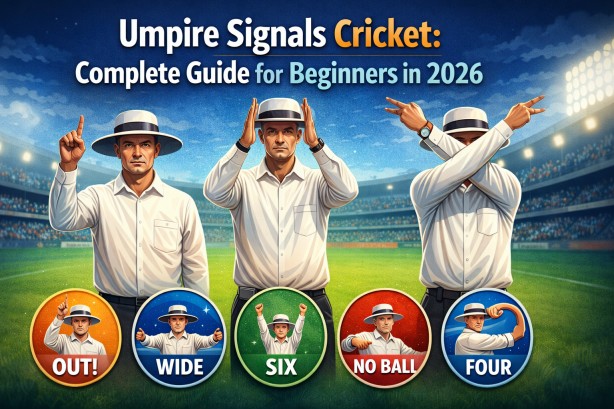
Cricket is a sport governed by clear rules and communication between players, officials, and spectators. One of the most important forms of communication on the field comes from the umpire. Umpire signals cricket are specific hand gestures used by umpires to inform players, scorers, and the audience about decisions during the match.
Understanding these signals helps fans follow the game more easily and adds to the excitement of watching cricket. In this article, we will explain the most common umpire signals cricket and what each one means.
What Are Umpire Signals in Cricket?
In cricket, umpires use hand gestures to indicate events such as runs, boundaries, wickets, extras, and other decisions. These gestures ensure that scorers and players clearly understand what has happened during the game.
Without these signals, it would be difficult to maintain accurate scores and match records.
Common Umpire Signals in Cricket
1. Out Signal
When a batter is dismissed, the umpire raises one finger straight up in the air.
Meaning:
The batter is out and must leave the field.
This signal is commonly seen after decisions like bowled, caught, LBW, or run-out.
2. Four Runs Signal
When the ball reaches the boundary after touching the ground, the umpire waves one arm back and forth across the chest.
Meaning:
The batting team scores four runs.
3. Six Runs Signal
If the batter hits the ball over the boundary without touching the ground, the umpire raises both arms straight above the head.
Meaning:
Six runs are awarded to the batting team.
Read For More Blog – no ball free hit rules
4. No Ball Signal
The umpire extends one arm horizontally to the side.
Meaning:
The bowler has delivered an illegal ball, such as overstepping the crease.
Penalty:
The batting team gets one extra run and the batter cannot be dismissed in most ways.
5. Wide Ball Signal
Both arms are stretched out horizontally.
Meaning:
The ball was too wide for the batter to reach.
Penalty:
The batting team receives one extra run.
6. Bye Signal
The umpire raises one arm above the head with an open palm.
Meaning:
Runs scored without the ball touching the bat or the batter’s body.
7. Leg Bye Signal
The umpire taps one raised knee with a hand.
Meaning:
Runs scored after the ball hits the batter’s body but not the bat.
8. Dead Ball Signal
The umpire crosses and uncrosses both wrists in front of the body.
Meaning:
The ball is no longer in play.
9. Short Run Signal
The umpire touches one shoulder with the opposite hand.
Meaning:
A run is not counted because a batter failed to ground the bat behind the crease.
10. Third Umpire Decision
The on-field umpire makes a rectangle shape with both hands.
Meaning:
The decision is referred to the TV umpire for review.
Why Umpire Signals Are Important
The system of umpire signals cricket plays a crucial role in maintaining fairness and clarity in the game.
Key benefits include:
-
Clear communication with scorers
-
Transparency in decisions
-
Accurate match scoring
-
Better understanding for spectators
Without these standardized signals, managing a professional cricket match would be much more complicated.
Modern Technology and Umpiring
Today, technology like the Decision Review System (DRS) supports umpires in making accurate decisions. However, even with advanced technology, traditional umpire signals cricket remain essential for communicating decisions during live matches.
Conclusion: umpire signals cricket
Cricket umpire signals are a vital part of the game. These gestures help players, scorers, and fans understand what is happening on the field instantly. From boundary signals to dismissal decisions, learning umpire signals cricket makes watching and enjoying the game much easier.
As cricket continues to grow globally, understanding these signals will help fans appreciate the sport even more.
FAQs: umpire signals cricket
1. What are umpire signals in cricket?
Umpire signals are hand gestures used by umpires to communicate match decisions such as runs, wickets, wides, and no-balls.
2. Why do umpires use signals in cricket?
Signals help communicate decisions clearly to players, scorers, and spectators.
3. What does the raised finger signal mean in cricket?
A raised finger indicates that the batter is out.
4. What is the signal for six runs in cricket?
Both arms raised straight above the head indicate a six.
5. What is the signal for a wide ball?
The umpire stretches both arms horizontally to signal a wide ball.